
Nursing Home Flooring: A Buyer's Guide to Safe, Low-Odour Rubber Surfaces
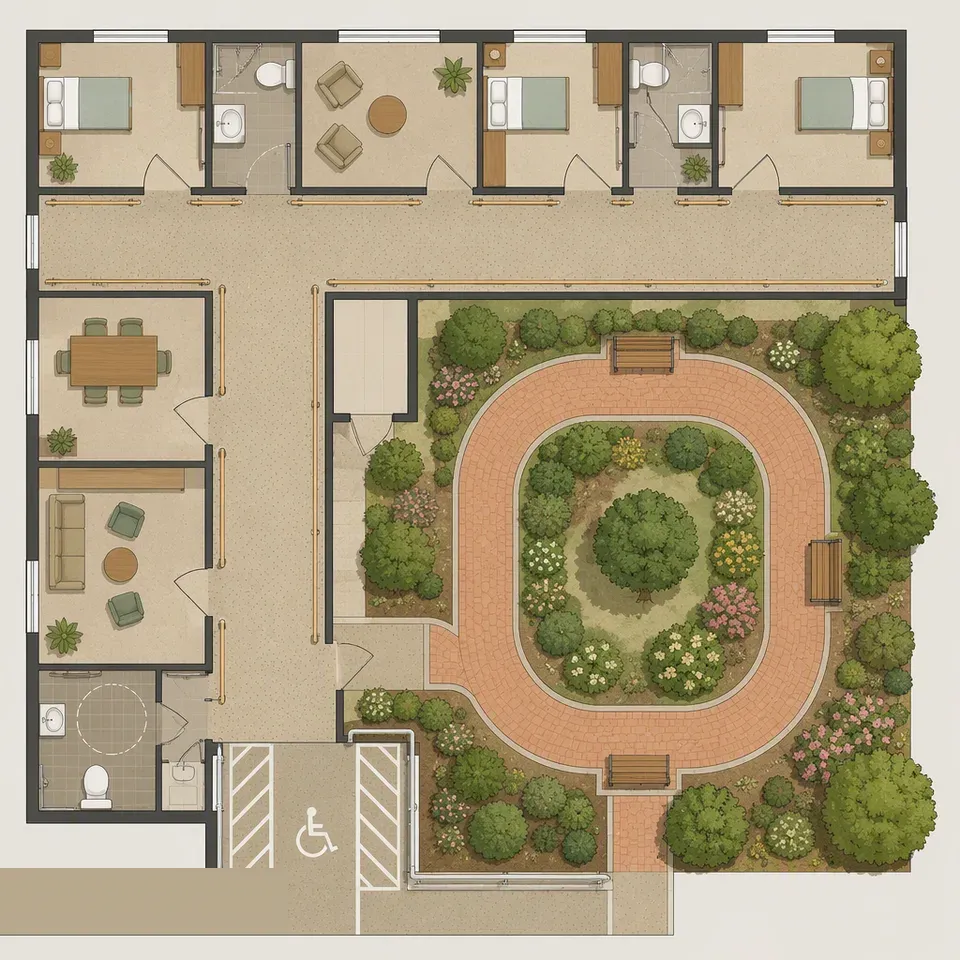
Falls are the leading cause of injury in senior living facilities, and the floor is the single largest injury-prevention surface in the building. Rubber flooring wins in nursing homes for four reasons: slip resistance that holds up when wet, impact absorption that lowers fall-injury severity, a surface that is easy to sanitize daily, and — with the right product — zero detected hazardous substances in the material itself.
Quick answer: for nursing homes and aged-care facilities, specify 8–15 mm rubber flooring with a certified slip-resistant surface, demand a hazardous-substance test report on the actual product (our GB 36246-2018 panel, report GT250048, shows all tested hazardous substances not detected), choose low-odour material rated grade 3 or better, and confirm the surface supports wheeled traffic — wheelchairs, walkers and meal trolleys run on it all day.
Mingren Rubber, a rubber flooring manufacturer in China exporting to 18+ countries, supplies recycled rubber flooring to healthcare and eldercare projects. This guide covers the five specification decisions facility managers and their contractors actually face — and the test evidence to ask for with every quote.
Why rubber beats the alternatives in eldercare
• Wet slip resistance: textured, water-shedding rubber holds grip where vinyl gets slick and carpet retains moisture.
• Fall-impact cushioning: 8–15 mm rubber absorbs standing-height falls; vinyl and tile do not.
• Sanitation: vulcanized rubber is non-porous, seamless after tight installation, and tolerates daily pH-neutral disinfection — no waxing, no carpet bacteria load.
• Wheelchair and walker traffic: at 55–75 Shore A the surface rolls smoothly without rutting, soft enough to cushion, firm enough for wheels.
The five specification decisions
1. Thickness — 8–15 mm, zoned. Corridors and rooms: 8–10 mm rolls or tiles. Wet rooms: textured glue-down tiles. Activity rooms where fall risk concentrates: 10–15 mm. You are protecting against falls from standing height, not dropped barbells; gym-grade 30–50 mm is rarely needed in eldercare.
2. Hazardous-substance evidence — the question almost nobody asks. Elderly residents have lower tolerance for VOCs and contact exposure, and care tenders increasingly ask for material safety data. Ask for the extractable heavy metals and PAH pages of the product test report. Our export product is tested to GB 36246-2018 (report GT250048): all tested hazardous substances — heavy metals, PAHs, plasticizers — not detected. One document answers most tender compliance tables.
3. Odour grade. Care facilities operate 24/7 and residents cannot be relocated during renovation. Require odour grade ≤3 test evidence and low-VOC adhesive systems.
4. Surface for wheeled traffic. Specify density 1.4–1.6 g/cm³ (hardness 55–75 Shore A): soft enough to cushion falls, firm enough that wheelchair and meal-trolley wheels do not dig ruts. Ask for abrasion data, not just hardness numbers.
5. Colour and wayfinding. Light, warm tones improve visibility for residents with declining vision. EPDM colour granules support custom colours from one 20GP container, and colour-zoning — corridor, room, activity space — doubles as passive wayfinding for dementia-care wings.
Installation and renovation notes
• Phased renovation without relocating residents: interlocking or glue-down 500×500 mm tiles install wing-by-wing, overnight, with sections back in service the next morning.
• Subfloor: level within ±3 mm per 2 m; moisture check before adhesive work.
• Adhesive: low-VOC polyurethane; ventilate for 24–48 hours after installation.
• Mixed-SKU containers: corridors in rolls, rooms in tiles, activity zones thicker — one container, MOQ 500 m² across models.
FAQ
**Is rubber flooring hygienic enough for nursing homes?** Yes. Vulcanized rubber is non-porous, seamless after welding or tight tile installation, and tolerates daily pH-neutral disinfection without degrading. It does not harbour bacteria or allergens like carpet, and needs no chemical wax polishes like vinyl.
**What test reports should a care-facility tender require?** Three documents: the hazardous-substance panel (heavy metals, PAHs — GT250048 shows all tested items not detected per GB 36246-2018), the physical performance report (density, tensile strength, abrasion), and fire rating per local code (GB 8624 B1 in our panel). Three pages cover most eldercare tender compliance tables.
**How long does installation take in an occupied facility?** A skilled crew lays 100–150 m² of interlocking tiles per shift. A 40-room wing typically completes over two to three night shifts, rooms back in service the following morning.
**Can rubber flooring handle wheelchair traffic long-term?** Yes, when density is specified correctly: 1.4–1.6 g/cm³ and 55–75 Shore A rolls without rutting and still cushions standing-height falls. Ask for abrasion data.
**What does nursing home flooring cost per m²?** It depends on thickness and format: 8–10 mm rolls are the most economical; 10–15 mm activity-zone tiles cost more. A zoned project typically lands well below uniform-thickness quoting. Send your floor plan for a zoned FOB quote within 24 hours.
The bottom line
Eldercare flooring is a safety specification, not a decor line item. Specify 8–15 mm by zone, make the hazardous-substance test report a hard requirement, lock odour grade ≤3, verify density for wheeled traffic, and use colour as wayfinding. The factories that can hand you GT250048-style evidence on the actual export product are the ones whose floors pass tender review on the first submission.
Questions About Your Project?
Our export team answers flooring questions daily — send your floor plan or specs and get a reply within 24 hours.